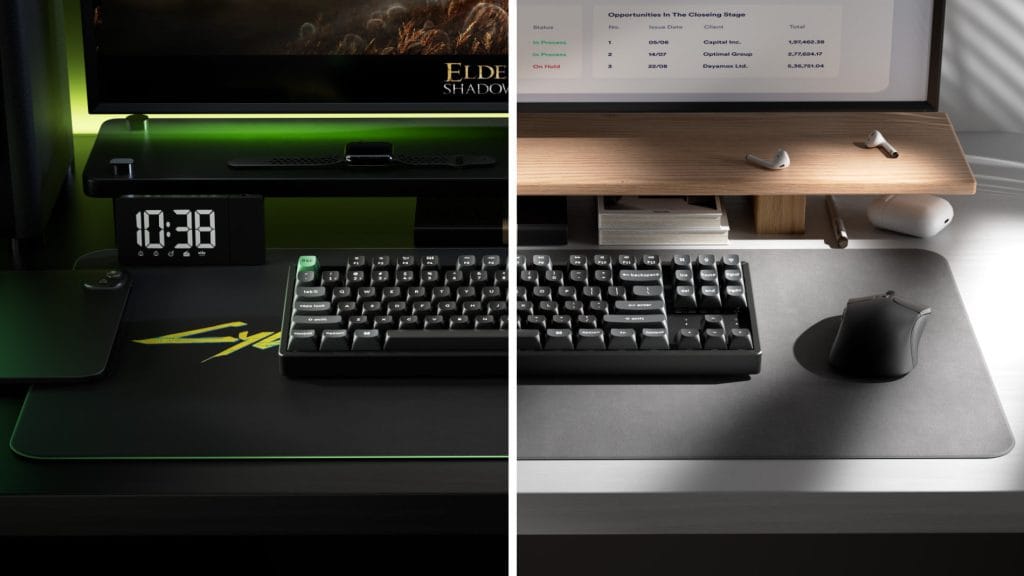
Both keyboards operate at up to 8,000 Hz in 2.4 GHz wireless and wired USB-C modes and that kind of responsiveness has traditionally come at the cost of battery endurance. Admittedly you’ll need to halve that responsiveness to fully reach the lofty 760-hour heights, but stretching usage out to a full month of solid work at 4,000 Hz is still mighty impressive.
The K2 Ultra takes a compact 75% layout with 84 keys, while the K8 Ultra opts for a tenkeyless 80% arrangement with 87 keys and the additional spacing that tends to suit gaming and productivity workflows. Beyond layout, the two share an identical platform. Bluetooth 5.2 and 2.4 GHz wireless sit alongside wired USB-C, and both feature hot-swappable Keychron APEX mechanical switches, double-shot PBT keycaps, south-facing RGB lighting, and full gasket-mounted construction.
Keychron has gone fairly deep on the acoustic engineering side as well. A multi-layer dampening stack combines IXPE, PET, EPDM, EVA, and silicone materials beneath the switches, which should translate to a deeper, less hollow typing sound compared to simpler foam-and-plate setups. The CNC aluminium frame adds rigidity and heft to the overall package, moving the K Ultra series firmly into enthusiast territory rather than the more accessible price points the original K series occupied.
It is worth noting that unlike the wave of magnetic Hall Effect keyboards that have dominated the enthusiast conversation recently, the K Ultra series sticks with traditional mechanical switches. Keychron is clearly targeting users who prefer the tactile familiarity of a conventional switch but still want wireless performance that can compete with wired alternatives. Customisation comes through ZMK’s open-source foundation and Keychron’s browser-based Launcher tool, which handles key remapping, macros, shortcuts, and RGB configuration.
The Keychron K2 Ultra and K8 Ultra are available now from Keychron’s website, starting at $119.99 USD.