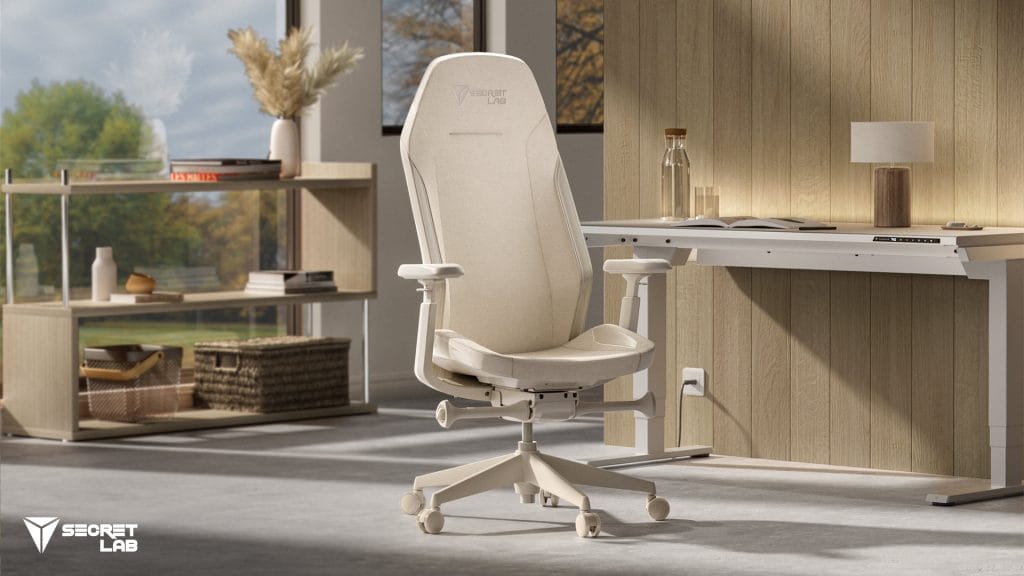
Rather than stretching mesh across a frame that supports the body from the sides, the ATLAS uses Secretlab’s proprietary cold-cure foam to support users from the bottom up, claiming more even pressure distribution and reduced fatigue over long sessions. It is available now from the Secretlab website, starting at £399 for the standard model and £599 for the ATLAS with NanoFoam Composite.
The main breakaway from Secretlab’s other chairs is the synchronous tilt mechanism, which moves the backrest and seat base in a calibrated 2:1 ratio. For every two degrees the backrest reclines, the seat tilts by one degree, opening the hip-to-torso angle to reduce spinal strain while keeping the seat base relatively level. Four tilt force settings let users dial the resistance up for a locked, upright working position or ease it back for a gentler rocking motion during breaks. The full recline tops out at 120 degrees, considerably less than the Titan Evo’s 165 degrees, but this is by design. Secretlab frames the ATLAS around two modes: focus, with the tilt locked upright, and rest, with the mechanism unlocked for free movement. It is a chair built around the idea that static posture is the enemy of sustained concentration, and that alternating between focused work and movement is how people actually get through a full day at a desk.
The ATLAS backrest itself is what Secretlab calls the RE-CURVE, a fixed S-shaped profile with integrated lumbar support sculpted from over a decade of user data. There is no adjustable lumbar dial here. Instead, Secretlab has baked curvature into the backrest’s structure using a hybrid spring-and-foam system that micro-flexes with movement. It’s a bet on passive ergonomics over manual adjustment, and it means the ATLAS has a noticeably simpler adjustment set than many competitors. Beyond the tilt mechanism, users get adjustable seat depth, adjustable seat height (intentionally set 4cm lower than typical to promote a grounded, flat-footed posture), and armrests that raise, rotate, and slide. The redesigned magnetic memory foam head pillow rounds out the package.
The chair ships in two sizes: regular, for users under 178cm and up to 100kg, and large, for those between 178cm and 195cm and up to 120kg. At roughly 25kg for the heaviest model, it is about a third lighter than the Titan Evo, thanks in part to a reinforced nylon wheelbase rather than the Titan Evo’s aluminium. The slimmer silhouette is a deliberate move towards something that sits more naturally in a home office than a full-size gaming chair.
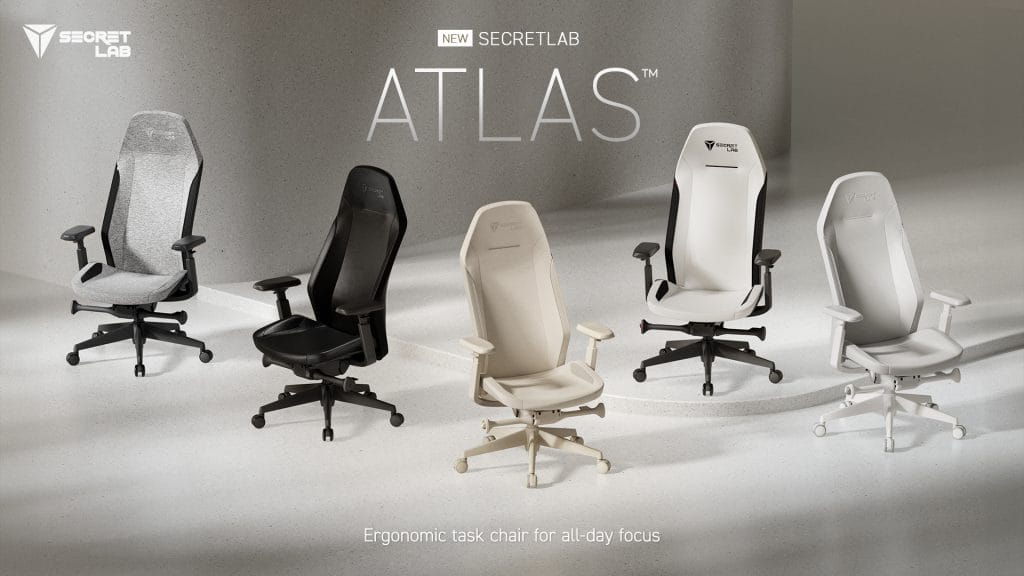
Two tiers are on offer. The standard Secretlab ATLAS pairs cold-cure foam with either NEO Hybrid Leatherette or SoftWeave Plus Fabric, with black hardware across all five colourways: Classic Black, Dune, Black3, Cookies and Cream, and Moon. The ATLAS with NanoFoam Composite steps up to a layered cold-cure and microfoam construction alongside colour-matched hardware, available in four options: Pure Black+, Dune+, Pure White+, and Black3+. The NanoGen Hybrid Leatherette is exclusive to the higher-tier models.
At £399 and £599, Secretlab is positioning the ATLAS below much of the traditional ergonomic task chair market while undercutting the Titan Evo’s upper trims. The entire design has been tested and certified by United States Ergonomics for optimal pressure distribution and natural movement, and Secretlab’s independent ergonomic advisory board, which includes biomechanics, orthopaedics, and physical therapy specialists, has validated the approach. Whether a fixed-profile, foam-first design can genuinely rival the adjustability of established mesh task chairs remains to be seen, but Secretlab is clearly betting that its material science and a decade of seating R&D can bridge that gap.