Dropping a gaming mouse from 99 grams to 59 grams usually means gutting features or tripling the price. Logitech reckons it can do neither. The G305 X Superlight takes the egg-shaped silhouette that made the original G305 one of the best-selling wireless gaming mice of the past decade and rebuilds nearly everything inside it, ditching the AA battery in favour of a rechargeable USB-C cell and swapping the ageing HERO 12K sensor for a HERO 44K unit capable of 44,000 DPI and 678 IPS tracking. That 40-gram weight reduction, roughly 40% lighter than the original, puts it within touching distance of Logitech’s own G Pro X Superlight 2 at a fraction of the cost.
The G305 X Superlight arrives alongside the G316 X 98 wired mechanical keyboard, expanding Logitech’s G3 Series alongside the already available G325 wireless headset. Both new products launch on 30 June 2026, with the mouse listed at £69.99 and the keyboard at £109.99.
Tri-mode connectivity is the other headline upgrade for the G305 X Superlight, adding Bluetooth and wired USB-C alongside Logitech’s Lightspeed wireless. The original G305 relied solely on a 2.4 GHz dongle, so the flexibility here is a meaningful step forward for anyone switching between a gaming PC and a laptop. Battery life is quoted at over 130 hours on Lightspeed, with a two-minute charge reportedly providing around 3.5 hours of playtime. It is worth noting that the mouse ships with a standard 1,000 Hz receiver. Reaching the 8 kHz polling rate Logitech references requires the separately sold Pro Lightspeed Receiver, which adds to the overall cost if low-latency competitive play is the goal. The mouse retains six programmable buttons and stores up to five profiles in onboard memory.
Logitech has also made some deliberate choices around longevity. The shell incorporates a minimum of 51% post-consumer recycled plastic, rising to 65% on the black model, and exposed screws on the chassis are intended to make the mouse easier to open and repair rather than replace.
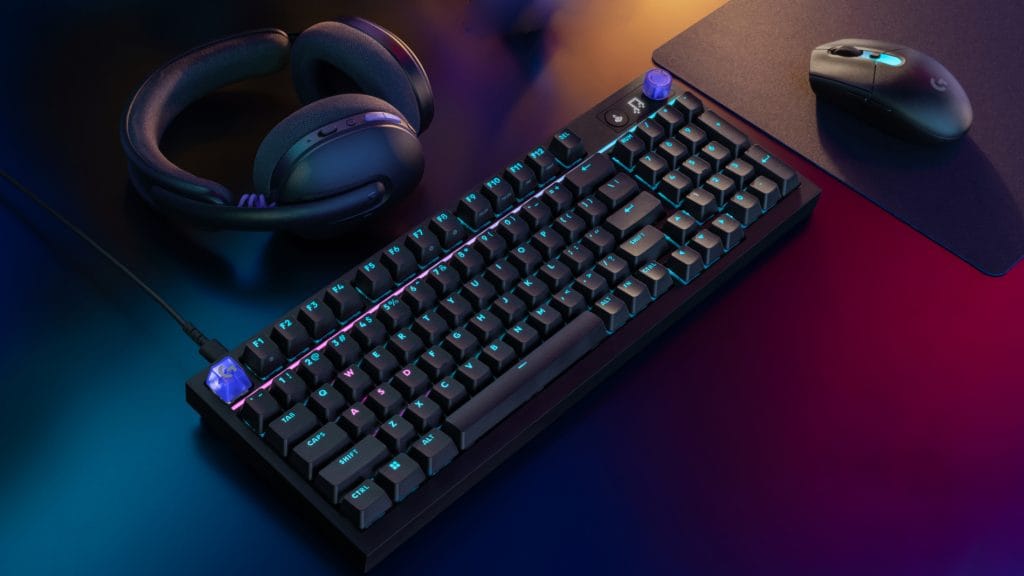
The G316 X 98 takes a different approach to value. It’s a wired-only, 98% layout mechanical keyboard, so it keeps the number pad while trimming a sliver of desk space compared to a full-size board. The headline spec is an 8 kHz polling rate, delivering a 0.125 ms response time. Buyers choose between a tactile switch with 2.2 mm actuation and 55 g of force or a linear option at 1.9 mm and 40 g, and all switches are hot-swappable with cross-hatch stem compatibility for aftermarket replacements.
Construction uses a screwless snap-fit gasket mount with internal sound-dampening layers, a design philosophy typically associated with enthusiast custom builds rather than mass-market boards at this price. Keycaps are double-shot PBT, and there is per-key RGB lighting alongside a 30-zone light bar. A small dot-matrix LED display and physical control dial in the top right corner handle volume, media playback, brightness, and polling rate adjustments without needing to open Logitech’s G Hub software. The keyboard weighs 920 grams with its detachable 1.8-metre USB-C cable.
Both products slot into a pricing tier that puts pressure on the budget and mid-range competition. The G305 X Superlight undercuts most current wireless mice offering comparable sensor specifications and sub-60-gram weights, while the G316 X 98 arrives at a point where gasket-mounted, hot-swappable keyboards with 8 kHz polling are still relatively uncommon without stepping into more expensive territory. Black and white colourways will be available for both at launch, with all G3 Series peripherals supported through Logitech’s G Hub software for customisation, macro profiles, and community-shared lighting presets.