Maono PD200W Hybrid Podcasting Microphone

design
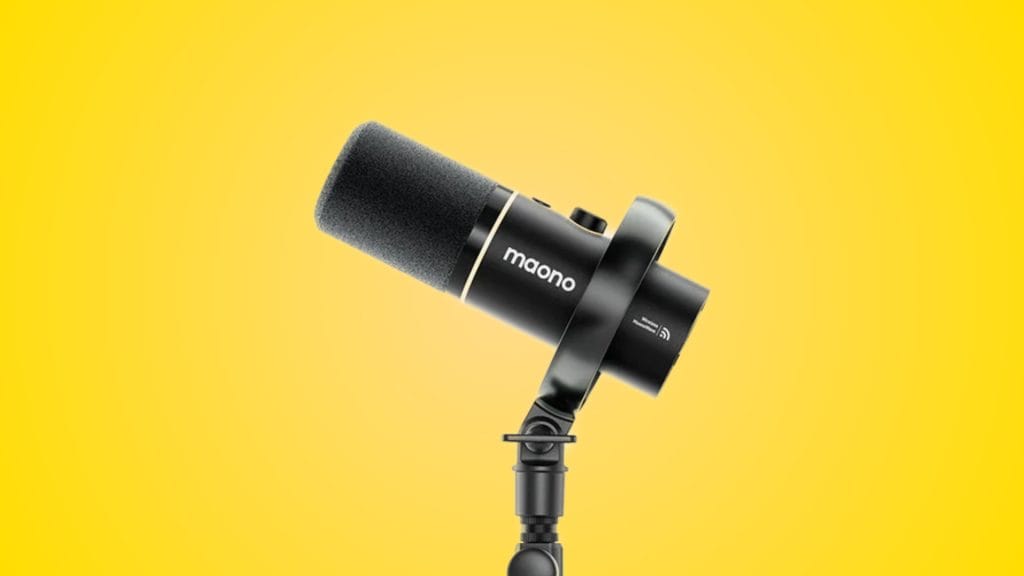
The Maono PD200W Hybrid podcast mic won’t win any awards for groundbreaking industrial design. It’s a round, black microphone that looks like, well, how most people would imagine a podcast microphone. There’s a foam pop shield in the top half, an LED ring around the middle, a control knob on top, and all your connections round the back. It’s only available in black, which is a shame and feels like a missed opportunity when half the streaming world is running white setups these days.
What does impress though is the build quality. The PD200W is almost entirely metal with a matte finish that manages to resist fingerprints surprisingly well. It feels substantial without being unwieldy or heavy, and there’s none of that hollow plasticky feeling you sometimes get with budget gear. The foam windsock deserves special mention because it might genuinely be the softest thing I’ve ever touched. I’m not sure what witchcraft Maono employed here, but this material has no business being this pleasant. I’d happily wrap myself in a blanket made of the stuff.

The Maono PD200W ships with a pre-installed shock mount, which immediately puts it ahead of plenty of pricier competitors that make you buy one separately. Admittedly it’s plastic rather than metal, but it does the job admirably with eight elastic suspension points and enough resistance in each to actually isolate vibrations properly. There’s also a desktop mic stand included – another freebie that brands like Shure and RODE tend to skip. The stand is basic but perfectly functional with a sturdy metal base that kept the mic secure in testing. I needed a thread adapter to mount it on my Elgato Wave Mic Arm Pro, but that’s par for the course with most microphones.
Around the mic you’ll find two LED rings – a larger one that wraps the entire body and a smaller one just around the control knob on top. These offer functional feedback rather than just decoration, turning grey when you’re adjusting gain, blue for headphone volume, and green when cycling through the three noise cancellation levels. The larger ring also does the usual RGB lighting party tricks if that’s your thing, though it’s so small I’m not convinced it adds much visual impact to your setup. More importantly, this lighting halves your battery life from a quoted 60 hours down to 30 if you’re using it wirelessly, and it won’t work at all in XLR mode since the mic essentially becomes passive when using that connection.

performance
The Maono PD200W uses a 30mm dynamic capsule, which is larger than most of the field and really rather impressive at this price. For context, the old-school streaming staple Blue Yeti uses 14mm capsules, the Audio-Technica AT2020 has a 16mm diaphragm, and even the legendary Shure SM7B sits around 25mm. That extra surface area means the PD200W can in theory capture more detail and depth than you’d expect from a sub-£100 mic, resulting in audio that sounds warmer and fuller than most budget dynamics manage.
I tested the Maono PD200W across all three connection modes and the quality remained consistent throughout. There are pros and cons to each connection type, though I imagine most people will have already decided what they intend to use before they buy. USB-C gives you plug-and-play convenience with access to Maono’s processing suite, including three levels of noise cancellation. XLR strips away all the digital features but delivers clean analog audio that your interface can work with – though be aware that switching to XLR means the on-mic controls completely stop working, the lights turn off, and you lose all the noise cancellation and software features. The wireless mode brings back the digital processing while freeing you from cables, though obviously you’ll need to keep an eye on battery life and connection.

The cardioid pickup pattern does a solid job rejecting noise from the sides and rear, making this a good choice for untreated rooms where you don’t want your recording picking up every keyboard click and PC fan whir. That said, being a dynamic mic with directional pickup means you need to stay fairly centred in front of it and treat it with a good level of mic respect. If your face drifts off-axis or you’re prone to jumping around a bit on stream the audio quality drops off noticeably.
Those connection options are great and all, but funnily enough it was the base audio quality is where the PD200W really surprised me. I swapped it into my streaming setup mid-broadcast without warning my viewers, replacing a Shure MV7+ that costs more than twice as much, and not a single person noticed. When I played back the recordings, I don’t think I’d have noticed either, though there was some quiet game sound and background music going on too. In some dedicated tests where I actually isolated the audio to compare them properly, yes, there were minor differences but the gap was minimal. In general the Maono PD200W delivered warm, full-bodied vocals with enough clarity to avoid sounding muddy, which is more than I can say for all dynamic podcast mics.

The wireless mode is meant to be the star feature here and I was pleased with what it offered. It comes pre-paired out of the box, so you literally just plug the tiny USB-C receiver into your device, power on the mic, and you’re ready to get recording. No pairing menus, no faffing about, it just works. Maono claims 60 meters of range and while I didn’t fancy hiking that far from my phone, I stress-tested it by leaving my phone downstairs and wandering up to the back bedroom, recording the whole way. It didn’t skip once and was consistent along the journey. Admittedly in a new build my walls aren’t particularly thick stone barriers, but the fact it handled multiple floors and basic obstructions without any signal dropout or interference impressed me considerably.
The thing is though, and this isn’t a negative as such, but I’m not sure realistically how useful the wireless feature is. It works perfectly well, but I’m not sure when most people will actually get much use from it. Out and about I’m far more likely to look to a RODE Wireless Micro or Hollyland Lark M2S than lug around a full size mic and shock mount. If I’m in a setup where I can use the included stand, well I’ll probably just run a USB-C cable to my laptop and do away with any risk of interference or battery. Wireless mode works well on the Maono PD200W, I’m just not sure I’ll ever turn to it.

There are compromises too of course, unsurprising and largely unavoidable at this price. The control knob feels noticeably cheaper than the rest of the unit and spins freely with no physical stops, so you’re relying on LED brightness or software to know where your levels are actually set. The mute button is a physical click rather than capacitive touch, and despite my best efforts to press it gently, that click came through in every recording. And perhaps most annoyingly, the wireless receiver is super compact for use with phones but irritatingly wide for laptops. Plugging it into a MacBook Air blocked both the adjacent USB-C port and the MagSafe charging connector, not ideal when you’re out and about.
summed up
The Maono PD200W Hybrid podcast microphone manages to be both innovative, sensible, and surprisingly cheap, which is a tricky balance to strike. Triple connectivity sounds like a gimmick, and it is to an extend, but it’ll be a game changer for the right setups. Need to quickly record something on your phone? Wireless. Want clean analog signal for your interface? XLR. Just want plug-and-play on your PC? USB-C. Having all three deliver high quality audio in one package that’ll likely cost you under £100, with a shock mount and stand thrown, in is frankly ridiculous value.
That said, it’s not perfect. The control knob feels cheap, the mute button click bleeds into recordings, and that wireless receiver will hog your laptop’s ports if you’re not careful. The cardioid-only pattern means you’re stuck addressing it directly, and switching to XLR mode strips away every digital feature the mic has. For some folks, those will be dealbreakers, for others they won’t matter at all. For solo creators, podcasters, and streamers looking for flexibility without spending Shure money, the Maono PD200W is an easy recommendation. You’ll struggle to find better audio quality at this price, and even if you only ever use one of the three connection modes, it’s still a smart buy.