PXN VD6 Direct Drive Bundle and GT ONE Wheel
design
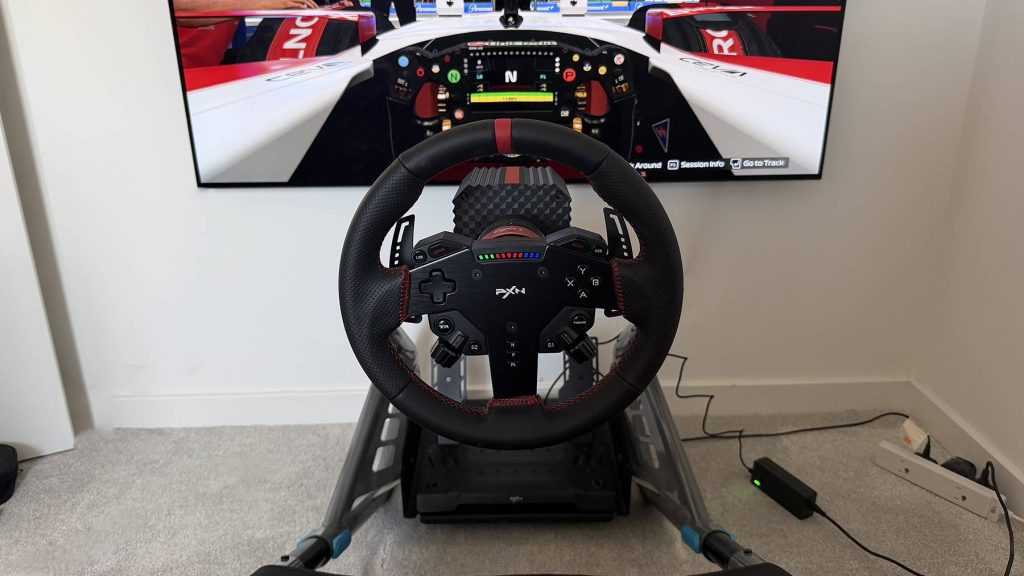
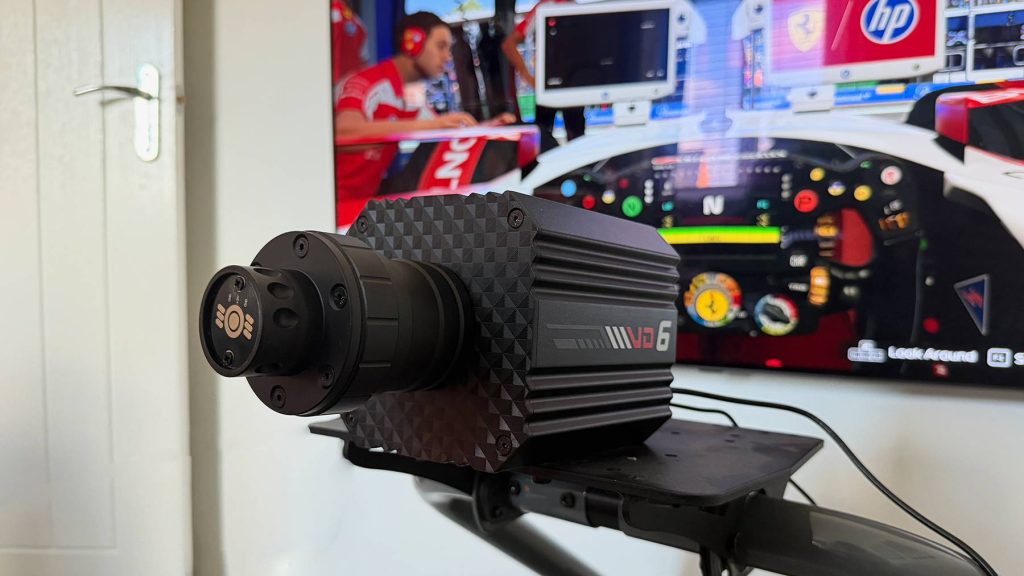
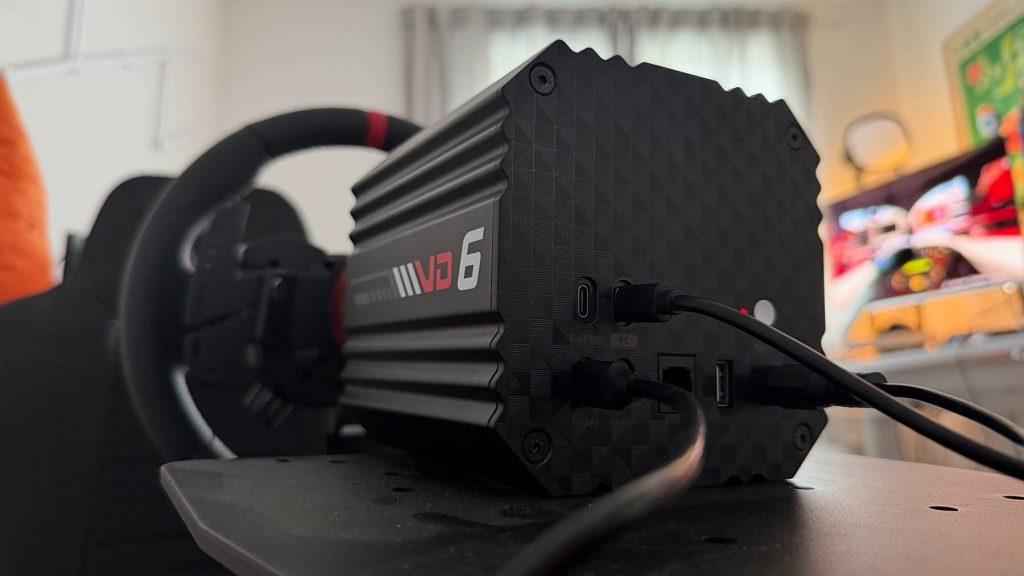
Sim racing hardware has very clearly settled into a look, much like Formula One cars towards the end of a generation, there’s convergence. It’s a black box with finned sides, connectors round the back and a quick release at the front, and the PXN VD6 follows the template to the letter. I could describe a wheelbase in my sleep by now, so I’ll spare you the poetry. The template works, and the VD6 doesn’t try to reinvent it. It looks the part.
I came into the PXN VD6 Bundle braced for the compromises that usually come with gear at this price, and I couldn’t find any in the base itself. It’s weighty and solid, the aluminium shell feels premium in the hand and helps with heat management, and nothing on it jumped out as a worry. That’s arguably the most important bit taken care of, which is handy, because the rest of what’s in the box is a step down.
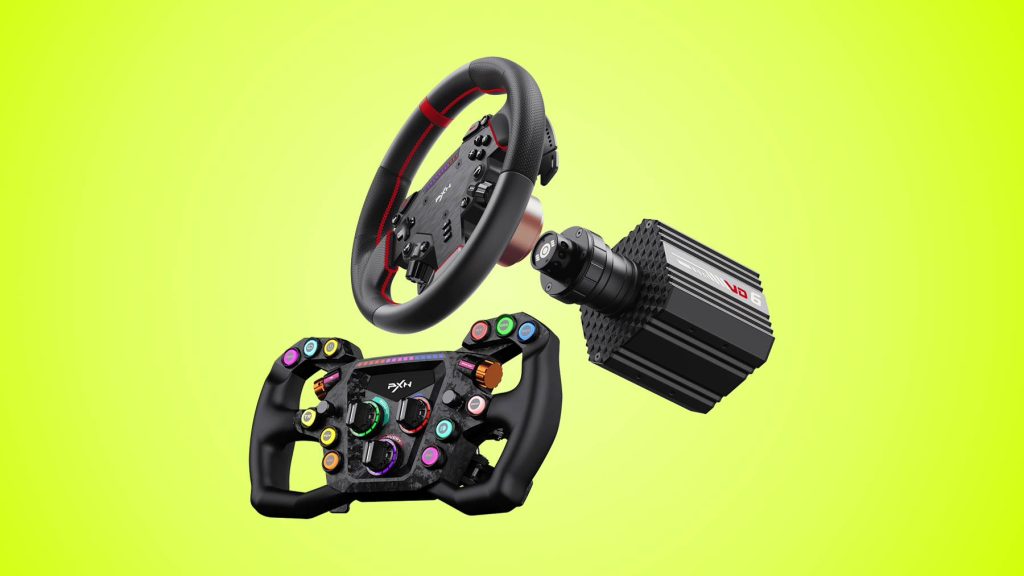
The 280mm round wheel has a textured and stitched faux leather rim, 12 buttons, a D-pad, two rotary encoders and RPM lights, along with aluminium shift and clutch paddles that use Hall effect sensors, which I didn’t expect at this price. It’s a perfectly capable wheel, but it isn’t in the same class as the base, and the pedals tell the same story.
The PD HM pedals are a simple two-pedal set, with an optional clutch pedal that can be added later. Both use Hall effect sensors, so there’s no load cell on the brake, and the resistance felt relatively light on both. They plug into the back of the wheelbase, which has a USB hub with a couple of spare ports for a shifter or button box. It’s worth bearing in mind that the whole bundle is PC only, with no official console support at all.
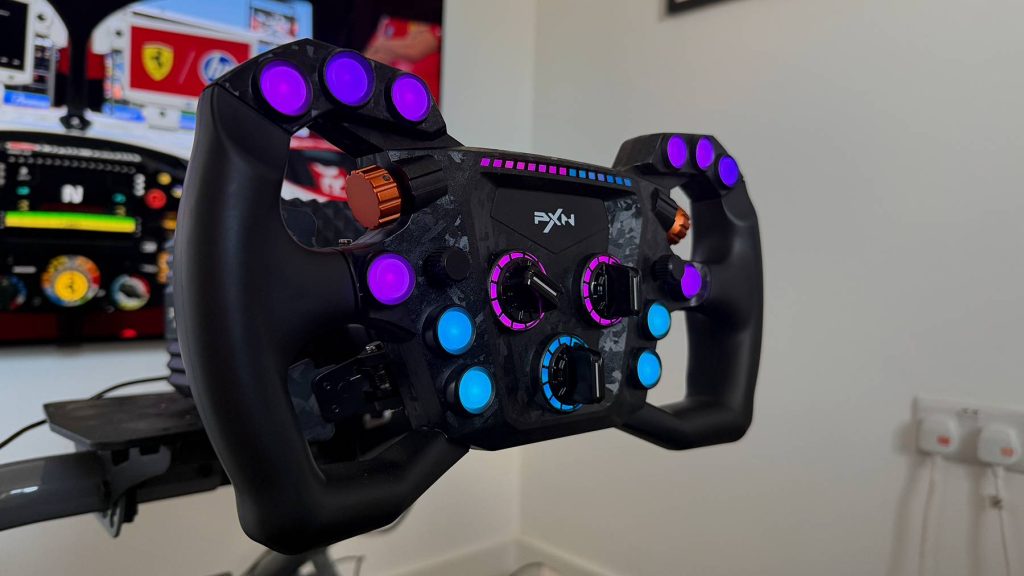
The standalone GT ONE wheel is a whole other story. Where the bundled wheel leans towards being more of an arcade-level accessory, the GT ONE is laid out like it means business. There are 12 larger, backlit buttons arranged in a more authentic way, and PXN includes a sticker sheet so you can label each one yourself. Around them sit three rotary encoders on the face, two thumb encoders, two directional thumbsticks, magnetic shift paddles, Hall effect clutch paddles and a row of RPM LEDs along the top. The rubber on the grips is comfortable and feels more grown-up than the faux leather on the default wheel, the rim has a good weight to it, and the quality matches the base’s self-assured feel. I found myself not wanting to switch back.
The GT ONE isn’t flawless, mind. The brass-coloured thumb encoders are great, but it’s a shame they only turn and don’t push for a bonus input. The three on the face are the weak point, too light for my liking and far too easy to overshoot when all I wanted was a single click.
performance
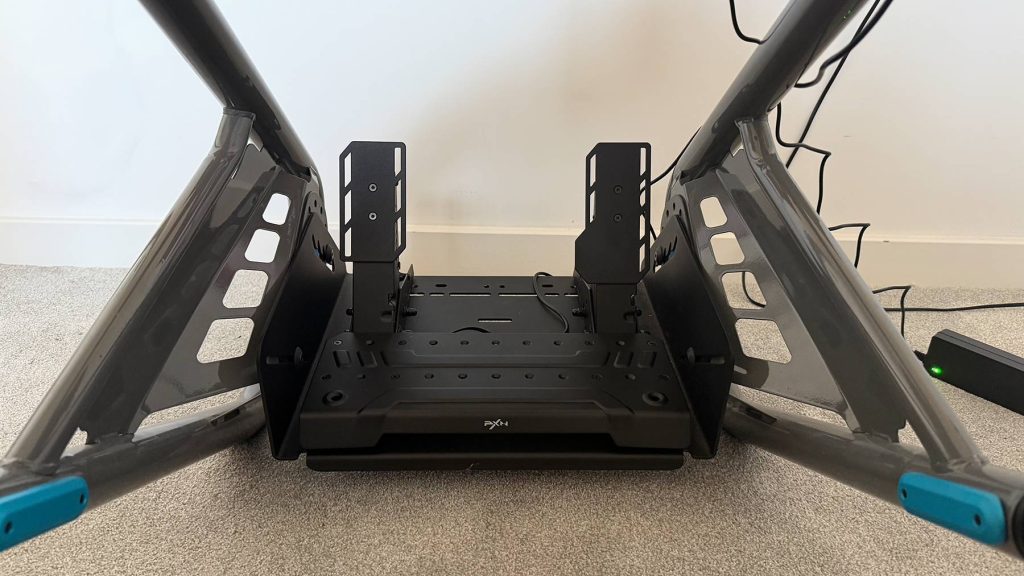
I skipped the included desk clamp, though it’s nice to see it there as standard, and bolted the VD6 to my Playseat Trophy Logitech G Edition, which has taken a bunch of other direct drive bases without complaint. It didn’t play along this time. I couldn’t find a set of holes on the mounting plate that matched all four bolt holes underneath the PXN, so I could only get a couple of bolts in whichever position I tried. It held firm enough, but it isn’t ideal. The pedals were the same and arguably worse, with a little play always present, particularly under heavy braking. One tip while we’re here: plug in all your cables before the pedals are bolted down, because doing it afterwards without unbolting everything is incredibly fiddly. Don’t ask how I know.
Getting out on track took far longer than it should have, and it’s where you notice you’ve left the well-trodden path of the big brands. Updating the firmware across the bundle ate a solid hour of my gaming time, with the pedals flipping from recognised to not recognised and the GT ONE refusing to show up at all until the wheelbase was updated. Update one part and the app would tell me another had rolled back, so I ended up rolling back and starting over several times before it finally stuck. It’s fine now, and the most recent wheelbase update went through smoothly, so fingers crossed PXN has things in order. The PXN SimRacing app does hold on to your settings, but it isn’t the most polished software I’ve used.
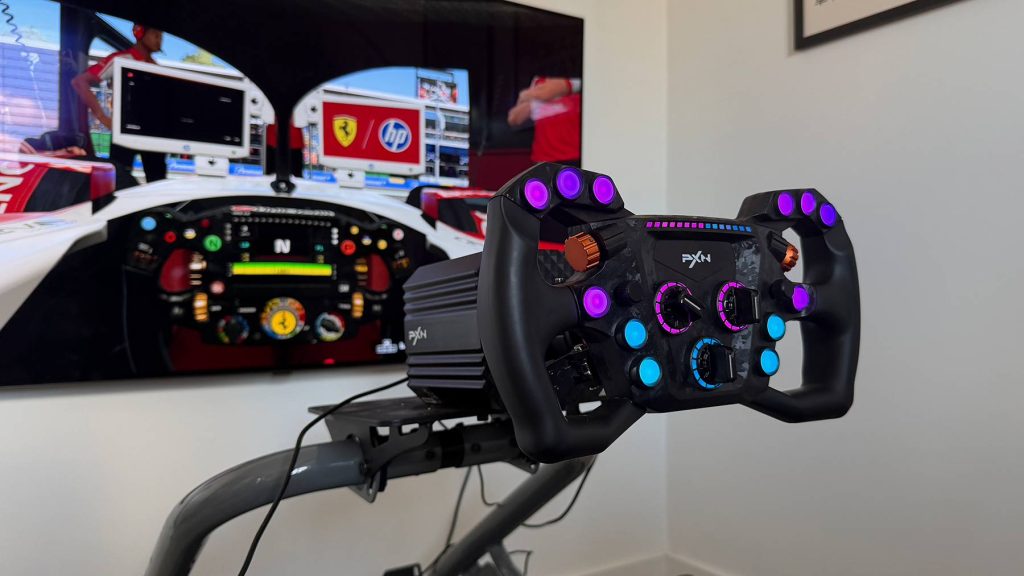
I spent most of my time in EA SPORTS F1 25: 2026 Season Pack, Forza Horizon 6 and EA WRC, all of which PXN lists as compatible. Every one of them still needed manual configuration and button mapping, even after I’d used the PXN app to supposedly set things up first. Once everything was mapped, the bundle worked reliably and force feedback came through in every game. F1 25 didn’t initially recognise the GT ONE’s directional switches as separate inputs, though a later firmware update appears to have fixed that.
Forza Horizon 6 took a lot of trial and error to dial in, which isn’t unique to PXN since I’ve found it fiddly on other wheels, but don’t expect to hit the streets of Tokyo straight away. It also strangely changed my frame rate in game to a cap of 60 while the wheel was connected. I put it back to 120 in the settings and it hasn’t returned, thankfully.
On track, 6Nm never felt short at my level, with plenty of resistance to lean on through long corners. I only turn a stronger wheel like the Logitech G Pro up to full whack for a laugh when someone new sits down and I fancy startling them, so you won’t need more than 6Nm for everyday racing. Force feedback is respectable and gets better the rougher the surface is. Riding a kerb or dropping a wheel into the gravel is always obvious, and there’s enough detail to tell what the car is doing. On the smooth sections, which is where you’re meant to be in F1 25, there’s less going on, though I felt some sensation on normal tarmac, which is more than I got from the Turtle Beach KD3. It’s not best in class. The Logitech RS50 and G Pro are still the best I’ve used thanks to TRUEFORCE, but there’s enough difference between surfaces to leave me feeling dialled in and immersed.
Shifting was nothing out of the ordinary, though it wasn’t quite as snappy as some other wheels I’ve used, and I had the odd missed quick downshift in F1 25. The base never got noticeably warm and I never heard a fan.
summed up
At £409/$379 for a wheelbase, wheel and pedals, the PXN VD6 Bundle goes toe to toe with the MOZA R5 bundle and comfortably undercuts the Nacon RS Pure and Logitech RS50. I’d say the base is better than that price suggests, even if the wheel and pedals don’t quite match it.
The GT ONE is a clear upgrade and one I’d recommend to anyone planning to spend serious time on track, though it skews the value quite considerably. The GT ONE and VD6 package is £469 without pedals, so a full setup lands at £560/$560. In the UK that sits just about level with a Logitech RS50 bundle including the track wheel and pedals, which comes to £550 in Logitech’s configurator. The US is a different story, where the same RS50 set comes to $750, close to $200 more than the PXN. The GT ONE is a nicer wheel than the one in that bundle, but the RS50 has a load cell brake, a smoother app experience, better game compatibility and the best force feedback I’ve tested with TRUEFORCE, so the question for US buyers is whether those are worth the extra.
If you’re a PC racer after a direct drive bundle on a budget, and you’re prepared to spend time on firmware and button mapping, the VD6 Bundle is pretty easy to recommend. Once everything is set up and mapped it’s a good experience, but PXN makes you earn it.