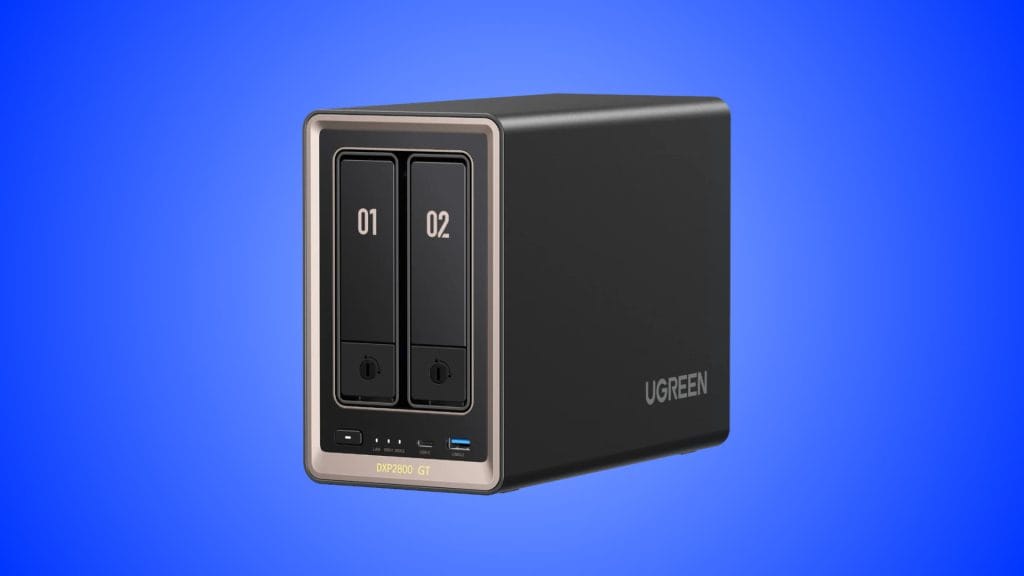
UGREEN NASync DXP2800 GT
design
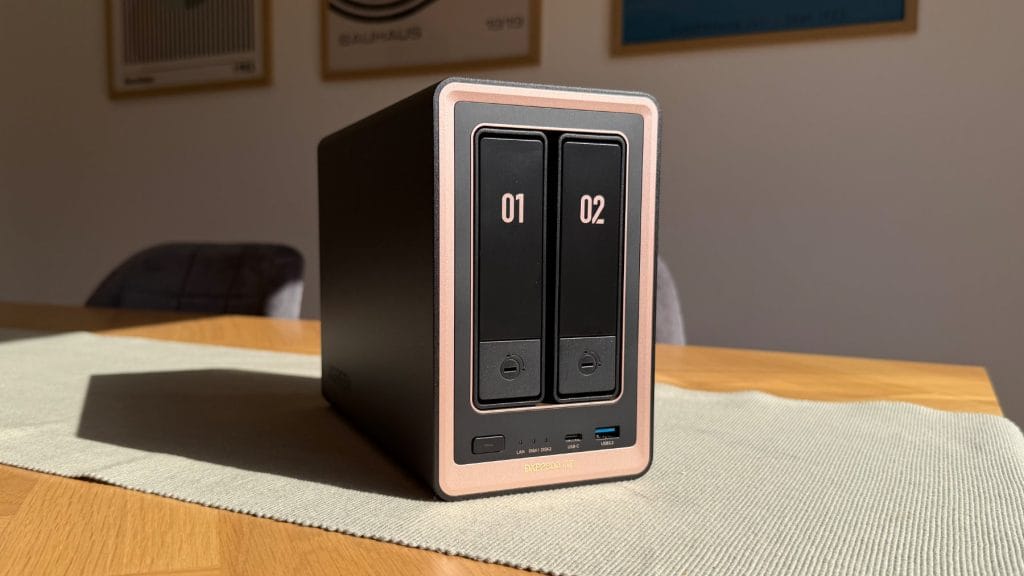
The UGREEN NASync DXP2800 GT follows the same design language that UGREEN has settled on across the NASync range. The gunmetal grey shell remains with its gently rounded corners, though on the GT models the dark, glossy front panel is framed by bronze plastic accents that give it a more distinguished look. It’s a smart enough unit to sit on a bookcase or a shelf in your office without looking like a piece of networking equipment that should be hidden away in a cupboard. The finish itself feels strong too, not that I expect you’ll be going hands on with your NAS too often. Materials feel premium and build quality is solid and convincing across the board.
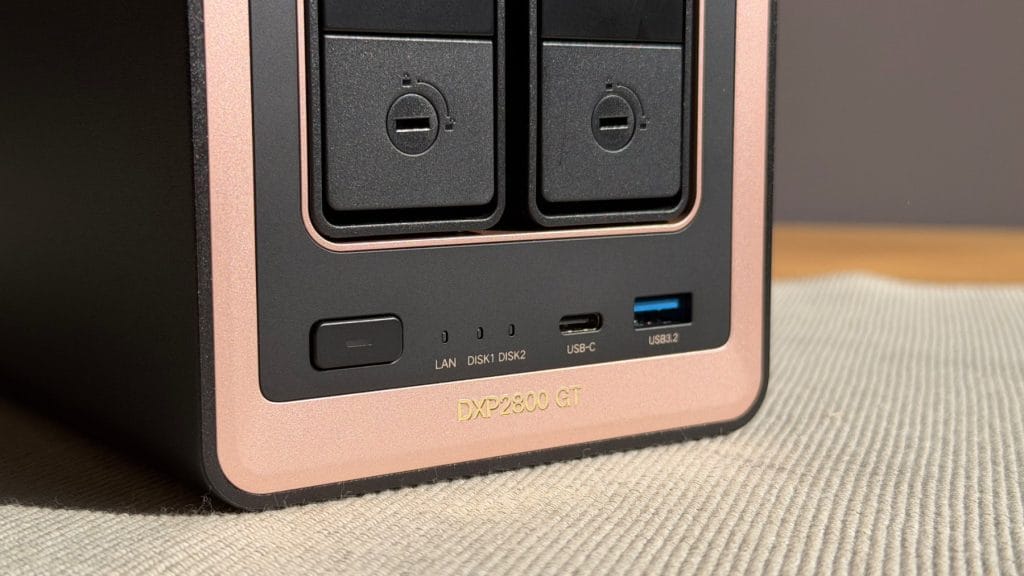
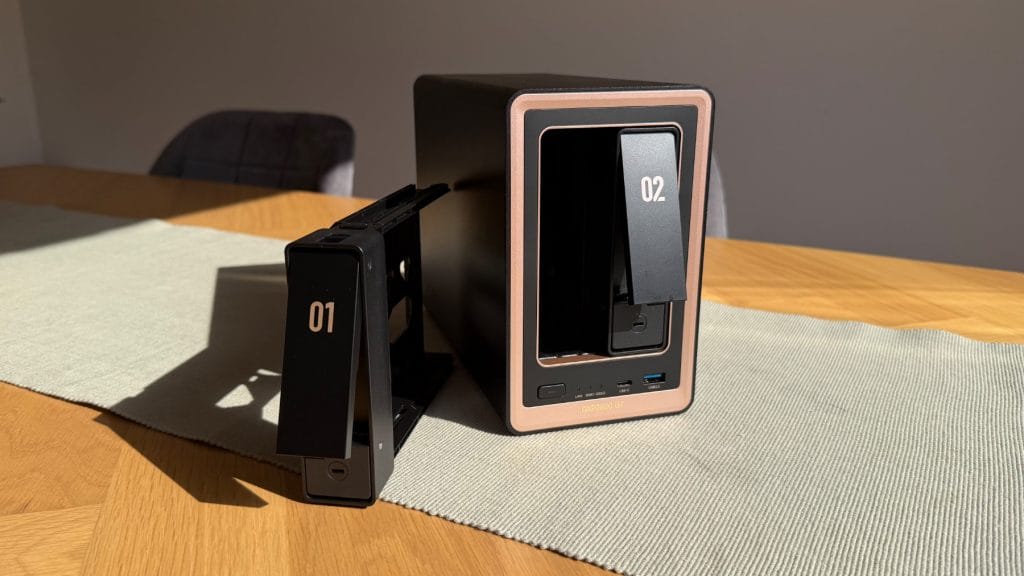
Below the two front drive bays, which are labelled 01 and 02 in the same bronze accent, sits a row of decent front-facing connectivity. You get a power button, LAN and disk activity LEDs, a USB-C port running at 10Gbps and a USB 3.2 USB-A port. Look around the back and you’ll find where the bulk of the connectivity lives: an HDMI 2.1 output, another USB 3.2 USB-A port, two USB 2.0 ports, a single RJ45 10GbE LAN port, a recessed reset button and the DC 12V power input. A large mesh grille dominates the rear panel, and the magnetic dust cover that UGREEN introduced on earlier NASync models is present and just as neat a design touch as ever.
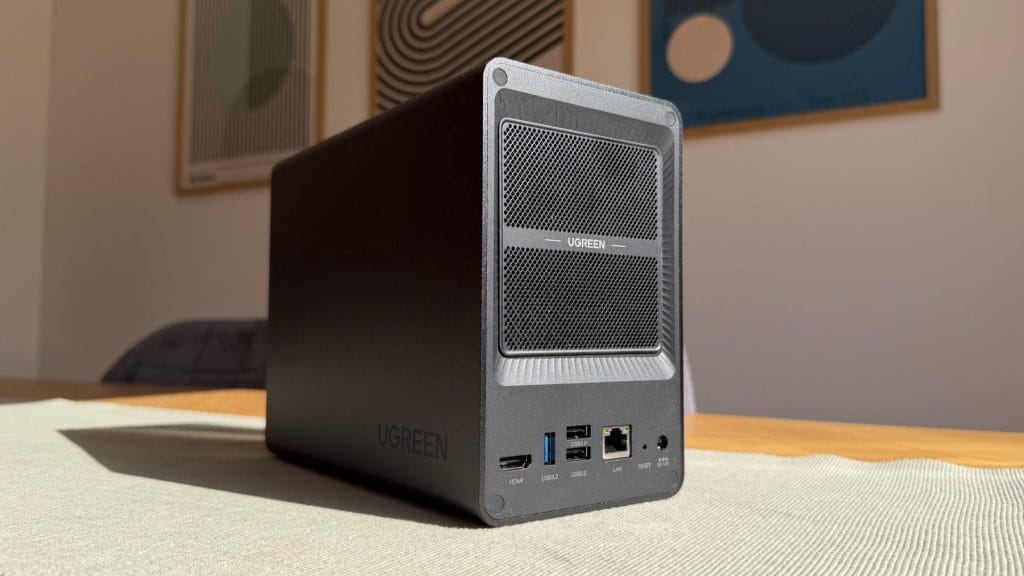
If you’re weighing up the DXP2800 GT against its four-bay sibling the DXP4800 GT, the internals are identical but there are a couple of changes to connectivity. Beyond the obvious extra two drive bays, the DXP4800 GT adds a second 10GbE port and an SD card slot that the two-bay model lacks entirely. Maximum raw storage capacity jumps from 80TB to 144TB, and the additional bays open up RAID 5 and RAID 6 configurations that simply aren’t possible with two drives. Whether there’s two or four of them, drive installation is toolless, as you would expect from any modern NAS at this price, and the lockable trays are a nice touch on a unit that you might leave somewhere accessible rather than locked in a server rack.
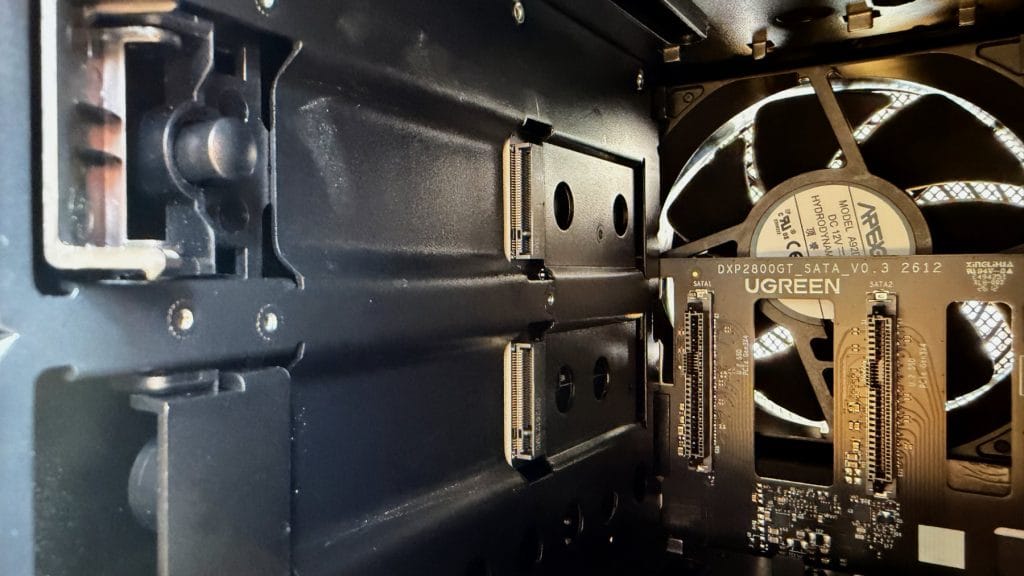
One oddity worth mentioning, and I’m not entirely sure what happened in the packaging department here, is that the two M.2 thermal pads are shipped loose inside the SATA drive bays. Not in a bag, not in a compartment in the box with the mini screwdriver, just knocking around freely inside the drive trays. One of mine had crumpled itself up against a tray when I removed the first drive bay. It survived with just a couple of creases, and it is nice to see thermal pads included rather than having to source your own, but there has to be a better transport solution than this.
The M.2 slot placement itself, on the other hand, is clever. Rather than burying them under the unit or behind a panel that requires you to flip the whole thing upside down, UGREEN has positioned the two M.2 2280 slots on the inner side of the NAS drive area, making them easily accessible without having to remove bottom covers or disassemble anything. It does mean you’ll need to whip out both drives to install them, but if nothing else that’s a good reminder that your NAS should be off before you do anything anyway.
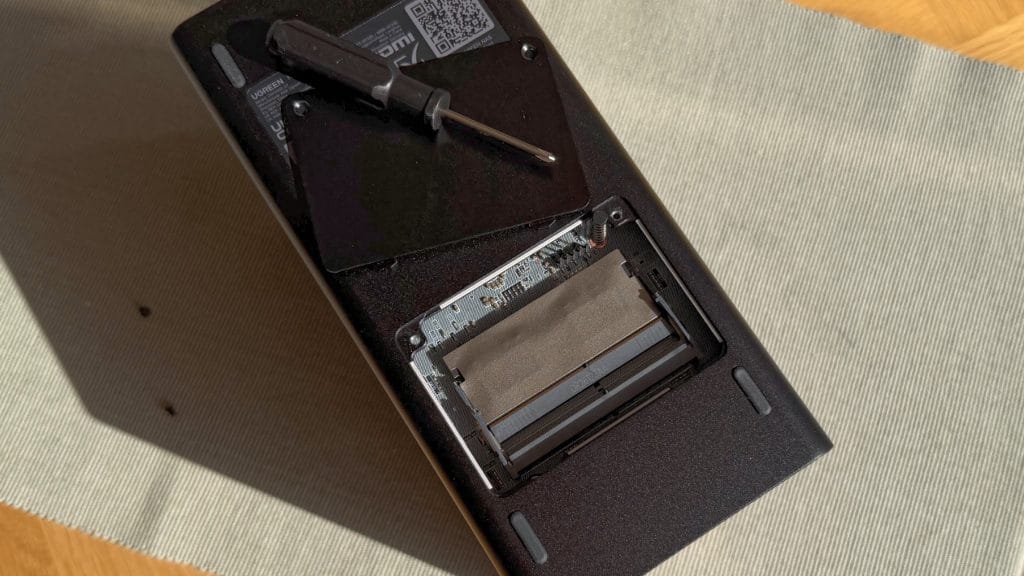
The UGREEN NASync DXP2800 GT ships with 8GB of DDR4 RAM, and the memory is accessed via a removable cover on the bottom of the unit. It is easy to get to, and the RAM is replaceable and upgradeable up to 64GB across two SO-DIMM slots, one of which is free out of the box. Worth noting here is that this is DDR4 rather than the DDR5 found in the original DXP2800 and the DXP4800 Plus, which might sound like a downgrade on paper but has a practical upside. DDR4 is significantly cheaper to buy right now, so upgrading this unit costs meaningfully less than doing the same on the DDR5 models.
performance
The shift to AMD silicon is the defining change with the GT series, and it’s worth understanding what that actually means in practice before getting into the day-to-day experience. The Ryzen Embedded R2514 is a 4-core, 8-thread processor based on AMD’s older Zen+ architecture, with a base clock of 2.1GHz and a boost up to 3.7GHz. It’s an embedded part, which means it is designed for sustained 24/7 operation rather than short bursts of desktop performance, and that philosophy suits a NAS down to the ground. It is not, however, as powerful as the Intel Pentium Gold 8505 found in the DXP4800 Plus. The Intel chip posts higher multi-threaded benchmark scores by a meaningful margin, and it has that single high-performance core that can turbo up to 4.4GHz for bursty tasks. For a NAS that spends most of its life shuffling files, running a handful of Docker containers and serving media, the gap is smaller in daily use than the raw numbers suggest, but it is there and you will notice it if you start pushing the unit with heavier parallel workloads.
To give you a sense of what the R2514 can handle in practice, I had a modded Minecraft server running comfortably on the DXP2800 GT, which is the kind of sustained, memory-hungry workload that would expose a weak embedded processor pretty quickly. It pushes the default 8GB of RAM towards its limits, making consistent use of the maximum 6GB I allowed it to use, but the server ran without complaint.
The more interesting question is what the AMD switch means for media serving, because this is where the platform choice really matters. Intel’s QuickSync has been the dominant hardware transcoding engine in the NAS space for years, and Plex, Jellyfin and Emby all lean on it heavily. The DXP4800 Plus, with its QuickSync support, handles 4K HEVC transcoding to lower resolutions with barely a flicker of CPU effort, and that has been one of its core strengths. The R2514’s Radeon Vega integrated GPU does have hardware encode and decode capabilities, and 4K transcoding through Plex does work, but AMD’s transcoding support in NAS media server software has historically been less consistent and less broadly supported than Intel’s implementation. If your media setup relies primarily on direct play to modern client devices, a recent smart TV, Apple TV, an Nvidia Shield, a current phone, the DXP2800 GT will still handle that without breaking a sweat. If you need a server that regularly transcodes content for multiple remote users streaming at reduced bitrates, the Intel-based models in UGREEN’s lineup remain the safer recommendation.
Both front bays on the NASync DXP2800 GT support U.2 NVMe SSDs as well as standard SATA drives, which is rather unusual at this price point and for a home-focused NAS. U.2 drives are enterprise-grade cards built for sustained workloads with far better endurance than consumer SSDs, and the ability to drop them into a compact two-bay NAS opens up some interesting possibilities for tiered storage. The realistic caveat is that U.2 drives are expensive and not something most home users are going to rush out and buy, but as a flexibility and future-proofing feature it’s a neat point of difference.
UGOS Pro, UGREEN’s Linux-based operating system, continues to mature at a decent pace. The interface is clean and approachable, Docker and virtual machine support work as expected, the mobile app is polished, and firmware updates have been arriving regularly. It is not Synology’s DSM, which has over fifteen years of development and an enormous app ecosystem behind it, but for the core tasks most home NAS users care about, file sharing, backup, media serving, Docker containers, remote access, it handles the workload without friction. The native app ecosystem is thinner than what you would find on Synology or QNAP, and if something does not work as expected the community troubleshooting resources are less established, but UGREEN has been closing that gap with each update and I’ve found its support department to be responsive and helpful when submitting tickets.
The single 10GbE port is a significant step up from the 2.5GbE found on the original DXP2800. It is worth noting, though, that getting the most out of 10GbE requires a 10GbE-capable switch and network adapter on at least one of your devices, which many home users simply will not have – I don’t. The absence of the second network port found on the DXP4800 Plus (which pairs its 10GbE with a 2.5GbE) does mean you lose the option of link aggregation or connecting to two different network segments, and that is a practical downgrade if networking flexibility matters to you.
summed up
The UGREEN NASync DXP2800 GT is a slightly unusual product in UGREEN’s lineup, sitting below the DXP4800 Plus in raw processing power and memory specification while adding impressive features like 10GbE, U.2 support and ECC compatibility. The AMD shift is an interesting one that will impact everyone differently, trading some of Intel’s transcoding maturity for an embedded platform built for sustained always-on operation and lower power draw. It is not trying to be the most powerful NAS UGREEN makes, and if you need four bays, broader RAID options and the strongest possible transcoding, the DXP4800 Plus remains the better all-round choice.
What the DXP2800 GT does well is offer a set of features that are hard to find together at this price. A two-bay NAS with those specs and a premium build for around £450 is a strong proposition, particularly against a competitive landscape where some established brands are still shipping two-bay units with 2019-era processors, 2GB of RAM and no NVMe support for a similar outlay. The NASync DXP2800 GT is not the right choice if your priority is heavy media transcoding or maximum storage capacity, but that is not what it is designed for. For home users, creators and homelab tinkerers who want a compact, well-built two-bay NAS with networking and storage features that punch well above its price, UGREEN has put together a package here that is very difficult to match in the current market.